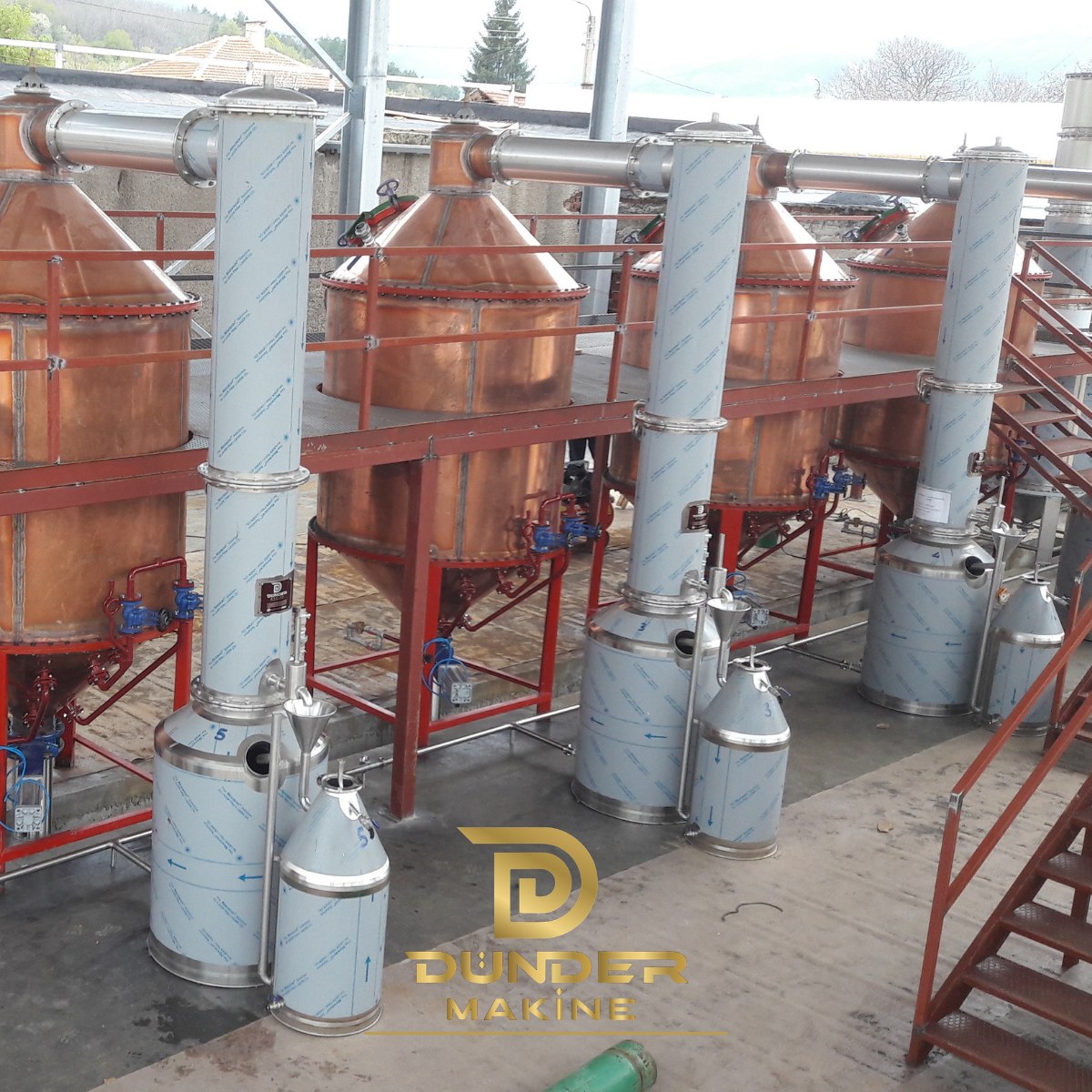
Between the still and the separator stands one of the most important parts of a distillation plant: the condenser column. This photo shows a row of copper rose stills on a red steel platform. In front of each still, a tall stainless steel condenser column rises from the floor.
What you see in the photo
The copper stills sit in the platform, with their cones above and their bases below. Then a horizontal pipe carries the vapour from each still head to the top of its condenser column. At the bottom, the cooled distillate flows into the conical Florentine separator. Also, the numbers on each column help the team track every line.
How a condenser column works
Inside the column, many tubes carry the hot vapour. Around them, cold water flows the other way. As a result, the vapour cools down and turns back into liquid. Then the liquid leaves at the bottom, ready for separation.
You can read more about the principle on the condenser page.
Why the condenser column matters
- Cool distillate: a cool liquid separates better and loses less aroma.
- Full capacity: a large column handles the full steam rate of the still.
- Water savings: a good design uses cooling water efficiently.
For example, if the column is too small, warm vapour escapes. In that case, you lose oil and aroma.
Sizing a condenser column
We size each column to the still volume, the steam rate and the cooling water temperature at your site. Therefore, a plant in a hot region often needs a larger column or a cooling tower.
In short, the condenser column protects your yield at the last step. See our essential oil distillation units for complete lines.
FAQ
Which material do you use? AISI 304 or 316 stainless steel.
Do I need a cooling tower? It depends on your water supply. So we check it during planning.
Planning a new line? Contact us.