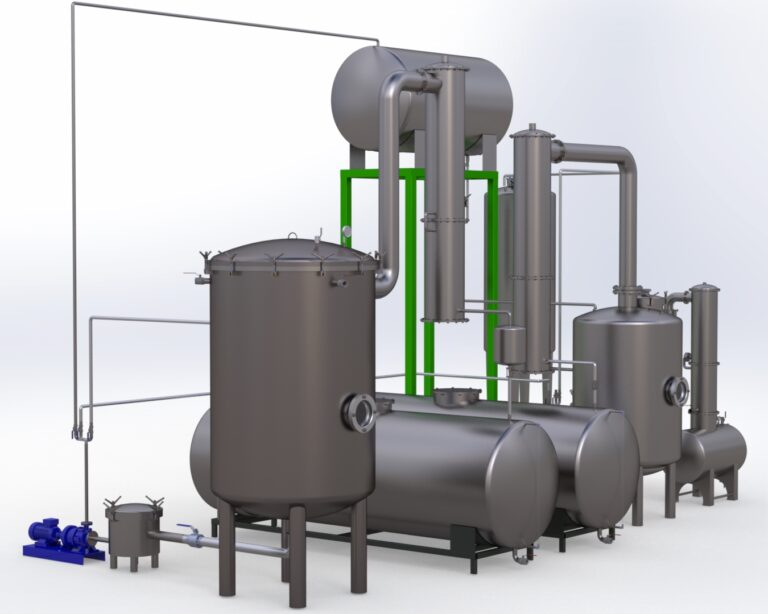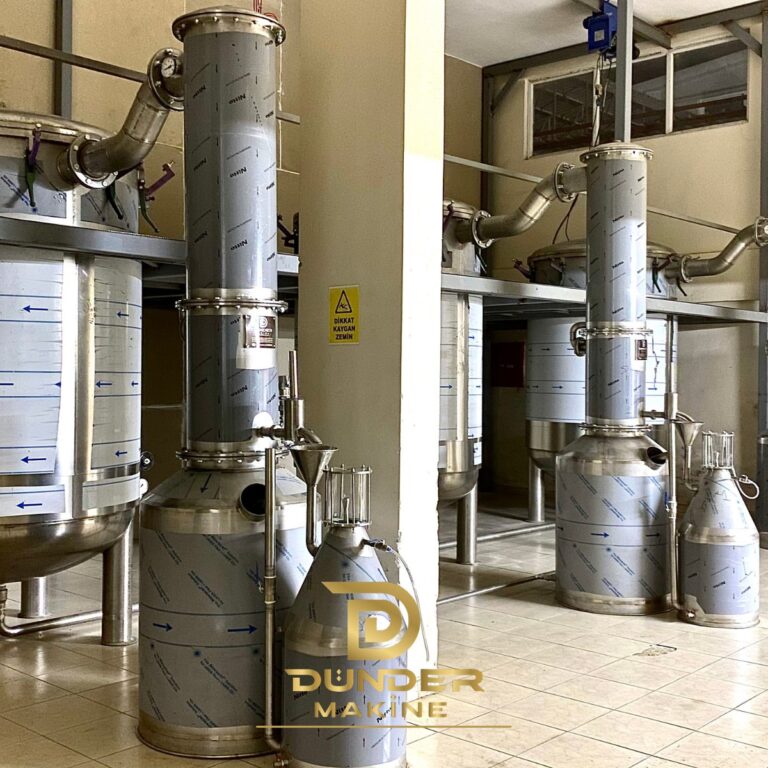
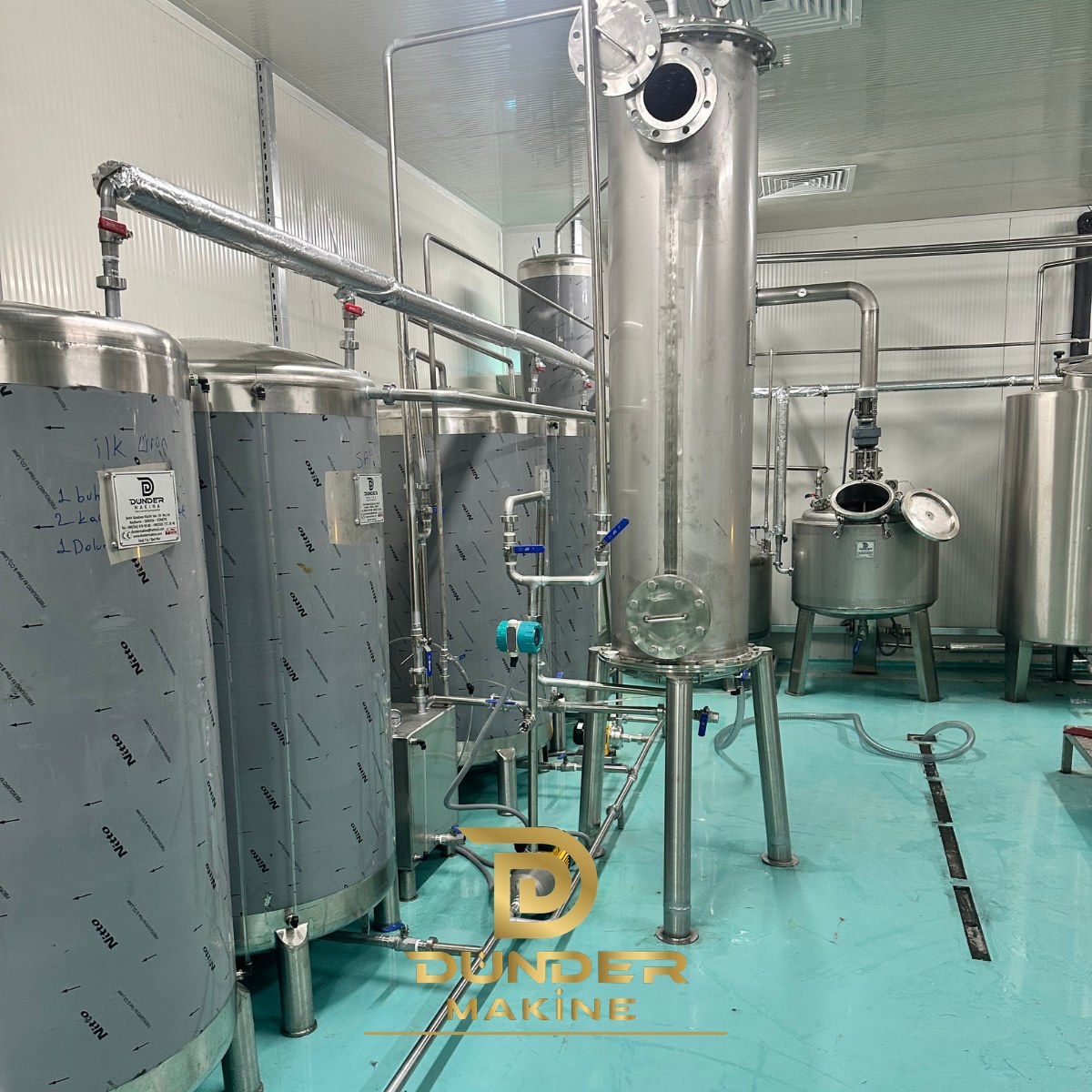
Some products need more than one simple run. They need separation into fractions, each with its own tank. This photo shows such a setup in a clean production room: a tall distillation column, a row of product tanks and a jacketed reactor.
What you see in the photo
- Distillation column (centre): a tall stainless steel column with inspection ports.
- Product tanks (left): each tank collects one fraction, and the labels show which.
- Jacketed reactor (right): a mixing vessel with a motor and a heating jacket.
- Sensors and valves: they measure the flow and route each product.
How the distillation column works
First, the mixture heats up in the vessel below. Then the vapour rises through the column. Inside, it meets cooler liquid flowing down. As a result, the lighter parts move to the top, while the heavier parts stay lower. Finally, the operator sends each fraction to its own tank.
You can read more about the principle on the fractional distillation page.
Why a clean room?
Food, cosmetic and pharmaceutical buyers expect clean production. Therefore, smooth walls, a coated floor and closed pipes help the plant meet their standards. In addition, the clean layout makes inspection and cleaning easier.
Benefits of a distillation column
- Sharper separation between products
- Higher purity in each fraction
- Solvent recovery for reuse
For example, a producer can split a crude oil into a light top fraction and a heavier main fraction. Then each one goes to its own buyer, so the same batch earns more. In addition, the column recovers the solvent, which lowers running costs over time.
In short, a distillation column gives you control over purity that a simple still cannot reach. See related systems on our industrial extraction systems page.
FAQ
Can it work under vacuum? Yes. Vacuum lowers the boiling point and protects heat-sensitive products.
Can you add sensors and automation? Yes. We fit level, temperature and flow sensors as needed.
Need a column for your process? Contact us.