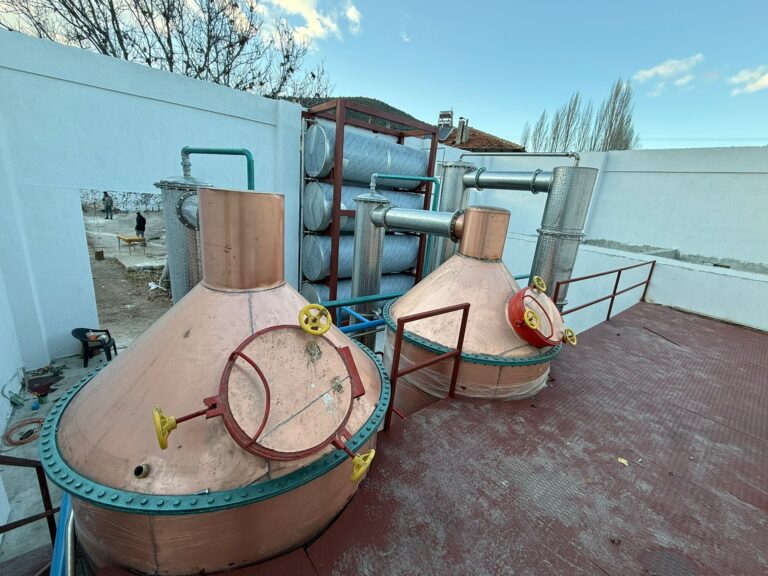
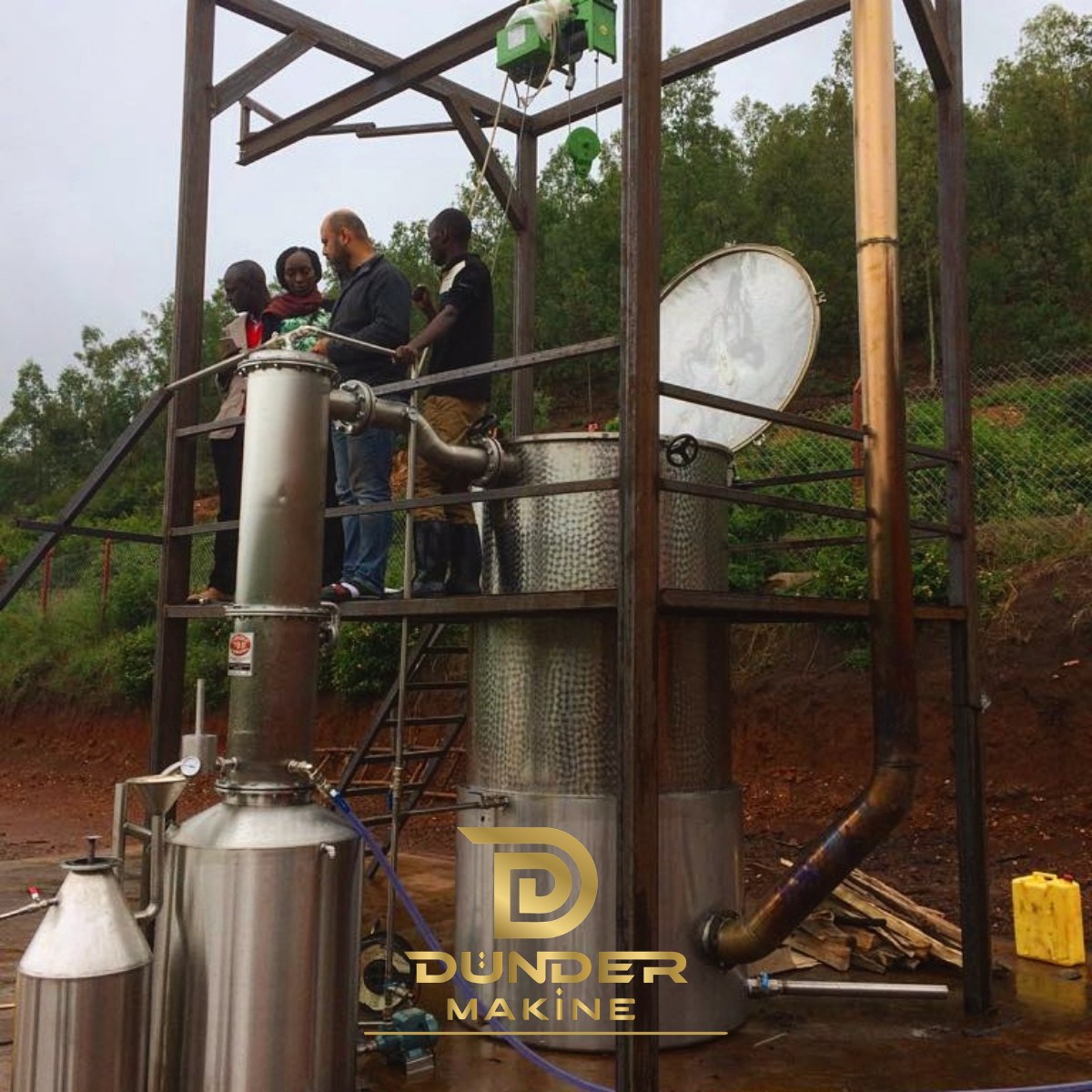
Some of the best aromatic plants grow far from power lines and gas pipes. For those sites, wood-fired distillation is often the most practical choice. This photo shows one of our units during start-up on a green hillside, with our engineer and the local team on the platform.
What you see in the photo
A steel frame holds a platform, a green electric hoist and a large still with a hammered stainless steel body. Below the still, a firebox burns local wood, and a tall flue carries the smoke away. Also, on the left, the condenser and the Florentine separator wait for the first distillate.
How wood-fired distillation works
- First, the team fills the still with plant material and water.
- Then the wood fire heats the water to the boil.
- Next, the steam carries the oil to the condenser.
- Finally, oil and hydrosol separate in the Florentine flask.
Why wood-fired distillation?
- No boiler needed: the fire heats the still directly.
- Local fuel: wood from the farm keeps costs low.
- Simple operation: a small team can learn it in days.
You can read more about the basic method on the steam distillation page.
Start-up on site
A new plant needs a careful first run. Therefore, our engineer stays on site to check the fire, the steam flow and the cooling water. In addition, he trains the operators until they run the unit with confidence.
In short, wood-fired distillation makes essential oil production possible almost anywhere. See our solid fuel models on the essential oil distillation units page.
Moreover, spent plant material from earlier batches can dry in the sun and feed the fire again. So the plant becomes partly self-sufficient in fuel, which keeps running costs very low in remote areas.
FAQ
Can I switch to steam later? Many designs allow it. So tell us your plans early.
Which fuels work? Wood, and in many cases other dry biomass such as spent plant material.
Planning a remote project? Contact us.