Most producers start with one process and one botanical. Then a second raw material arrives, or a customer asks for an absolute instead of an essential oil, and the question becomes whether to buy a second plant or to work with what is already installed. A dual-purpose unit answers that question by running both solvent extraction and distillation through the same vessel and the same recovery circuit.
What Is a Dual-Purpose Extraction and Distillation Unit?
A dual-purpose unit is a stainless steel system whose main vessel and condensing circuit can be configured to run either solvent extraction or steam and water distillation, with the process selected through the valve and pipework arrangement rather than by changing the equipment. One plant, two production routes, one footprint.
The reason this is possible at all is that the two processes share most of their hardware. Both need a sealed vessel that can be heated, both need vapour taken off the top, both need that vapour condensed, and both need the condensate separated and collected. What differs is what goes into the vessel and where the liquid is routed afterwards.
What the Photograph Shows
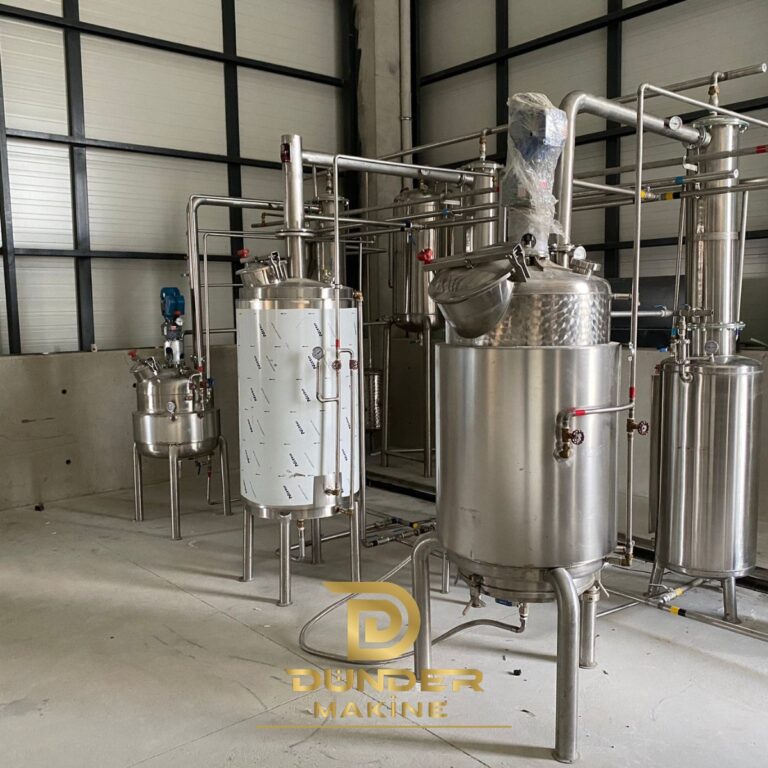
The image above is a compact unit in a tiled production room, and several details in it are worth pointing out because they are exactly what makes dual operation practical.
- Parallel routed lines with ball valves. The horizontal header at the top splits into two branches, each with its own valve. This is the switching mechanism: opening one route and closing the other sends the condensate down a different path, which is how the same hardware serves two processes.
- Sight glasses in both branches. The glass sections let the operator watch the liquid actually flowing. In distillation this is how you judge the rate and see the oil separating; in solvent service it confirms the line is running and not blocked.
- Florentine separator. The conical vessel in the centre is where essential oil and hydrosol separate by density after condensing. This is a distillation component, and its presence alongside the extraction circuit is what makes the unit dual-purpose rather than simply an extractor.
- Conical collection vessel. The tapered tank on the right drains completely to a small outlet, which matters when the product is a few hundred grams of oil rather than a bulk liquid.
- Pressure gauge on the vessel head. Distillation and extraction run at different pressures, so the operator needs to see the working condition at a glance rather than infer it.
- Top-mounted agitator on the receiving tank. The drive at the upper right keeps the collected product moving, which matters during solvent recovery and when handling material that would otherwise settle or stratify.
- Flanged and gasketed glass ports. Bolted sight ports let the operator see inside without opening the system, and the gaskets can be replaced without cutting into the vessel.
How the Two Processes Differ Inside the Same Vessel
Understanding what actually changes between modes makes it easier to judge whether one unit will serve your production.
| Stage | Distillation mode | Extraction mode |
|---|---|---|
| Charge | Plant material with water, or plant material with steam passing through it | Plant material with a measured volume of solvent |
| Driving medium | Water and steam | Alcohol, ethanol or hexane |
| What leaves the vessel | Vapour carrying volatile compounds | Loaded solvent, drained as liquid |
| Separation | Florentine flask, by density | Filtration, settling, then evaporation |
| Product | Essential oil and hydrosol | Concrete, oleoresin or extract |
| Recovery circuit | Condenser returns water | Condenser returns solvent for reuse |
The condenser, the vessel, the heating system and much of the pipework do the same job in both cases. That overlap is the whole basis of the design.
You can read more about both methods in these overviews of steam distillation and extraction.
Who Should Consider a Dual-Purpose Extraction and Distillation Unit
This configuration earns its place in a few specific situations.
- Producers working with several botanicals. Roses may go to distillation for oil and hydrosol while jasmine or tuberose go to extraction for concrete. One plant covers both seasons.
- Pilot and development work. Trialling a new raw material usually means testing both routes to see which gives the better yield and profile. Having both available on one system removes a purchasing decision from the experiment.
- Limited floor space. Two dedicated lines occupy roughly twice the area and need twice the utility connections.
- Constrained capital. One unit with dual capability costs less than two specialised plants, which matters when a business is establishing itself.
- Universities and research institutes. Teaching and research programmes need breadth of process rather than volume of output.
When a Dedicated Line Is the Better Choice
A dual-purpose unit is a compromise, and it is worth being direct about what you give up.
Changeover takes time. Switching between solvent and aqueous service means cleaning the vessel and the circuit thoroughly. If you are running both processes continuously through a short harvest, that downtime costs more than a second plant would.
Capacity is a single number. One vessel means one batch at a time. Two dedicated lines can run in parallel.
Neither process is fully optimised. A vessel designed only for solvent extraction can be built around that duty alone. A dual-purpose vessel carries the fittings and clearances that both processes need, which is rarely the ideal geometry for either.
Cross-contamination has to be managed. Solvent residue in a vessel that will next produce food-grade hydrosol is a validation question, not just a cleaning one.
If your production is high volume and single-process, dedicated equipment is the better investment. Our turbo extraction systems and rose oil distillation units are built for exactly that case.
Specification Points to Settle Before You Order
Solvent compatibility
If the unit will ever see flammable solvent, every seal, gasket, valve and electrical component in the system has to be suitable for that duty from the outset. Retrofitting this later is expensive and often impractical.
Cleaning and changeover procedure
Ask for the changeover procedure in writing before purchase, not after. How long it takes and what it requires determines whether dual operation is realistic for your schedule.
Heating flexibility
Distillation and solvent extraction often want different heating profiles. Confirm that the heating system covers both, whether through direct steam, indirect steam or a jacket.
Material grade
AISI 304 serves most duties. AISI 316 is specified where acids, chlorides or aggressive cleaning agents are involved, and a dual-purpose unit sees a wider chemical range than a single-process one.
Instrumentation
Two processes mean two sets of operating conditions. Pressure, temperature and flow indication should be readable in both modes without guesswork.
Frequently Asked Questions
Can one machine really do both extraction and distillation?
Yes, when it is designed for it from the start. The two processes share the vessel, heating system and condenser, and the production route is selected through valve and line configuration. A unit built only for distillation cannot simply be used with solvent afterwards.
How long does changeover between processes take?
It depends on the solvent, the product and the cleaning standard your market requires. This should be established with the manufacturer before purchase, since it determines whether dual operation suits your production schedule.
Does a dual-purpose unit yield less than a dedicated one?
For a given batch the process chemistry is the same. What you give up is throughput and optimisation, not yield per batch: one vessel runs one process at a time, and its geometry is a compromise between two duties.
What capacities are available?
Dual-purpose systems are engineered around the botanicals you process, your batch volumes and the products you intend to sell, rather than sold from a fixed model list.
Is it suitable for pilot and R&D work?
It is one of the strongest use cases. Development work benefits from having both routes available on one system so that a new raw material can be trialled both ways.
Can it be automated?
Yes. Valve sequencing, temperature control and process recording can be built into the system, which also reduces the risk of operator error during changeover.
A multi-purpose system on video
This video shows a multi-purpose botanical extraction system that can handle several processes.
Discuss Your Configuration
Whether a dual-purpose unit or two dedicated lines suits you better comes down to your botanicals, your batch volumes and how your season is structured. Tell us what you process and what you intend to sell, and our engineers will set out both options honestly. Contact us to start that conversation.
Dünder Makine has manufactured stainless steel distillation and extraction equipment since 1980, supplying turnkey plants to producers across the essential oil, cosmetics, pharmaceutical and food industries.